Showing posts with label Surrealism. Show all posts

Sunday, 23 October 2011

Julie Rrap: Camouflage #8 (Jeanne)

Julie Rrap's main focus has been the human body and its representations, with a particular emphasis on the female body within western art history. Over a 30-year period this interest has been explored through a variety of media that challenge conventions. Photography has been a particular focus and the use of digital techniques has allowed the exploration of surrealism and medical interventions into the body. Rrap has used numerous media, including sculpture, painting, drawing and video, often combined as installations.

Friday, 30 September 2011

Assemblages & Constructions

Jim Kazanjian’s surreal landscapes offer phantasmagoric visions of a where-is-this world, defined by impossibly complex architecture and M.C.Escher-esque black-and-white graphics. Inspired by the imaginary realms of cult author H.P. Lovecraft—whose wild short stories set the mold for much of the 20th century's best fantasy fiction—Kazanjian’s aim is to redress the “misunderstanding that photography has a kind of built-in objectivity…to defamiliarize the familiar.” 
Welcome to his surreal black and white world:


Friday, 2 September 2011

Frida Kahlo - A Few Small Nips 1935


Frida Kahlo - Self-Portrait with Cropped Hair 1940


“Self-Portrait with Cropped Hair” was the first self-portrait iconic Mexican painter Frida Kahlo created after her divorce from artist Diego Rivera. Renouncing the feminine image depicted in her other self-portraits, Kahlo (1907 – 1954) has just cut off the long hair Rivera admired, and is wearing a suit that was most likely his. Conveying the deep sorrow of her loss, the image appears to express Kahlo’s yearning for the freedom and independence of a man. The large empty space around Kahlo suggests the depth of her loneliness and misery, and the song verse above her reads, “See, if I loved you, it was for your hair, Now you’re bald, I don’t love you anymore.”


Frida Kahlo - Pitahayas (1938)


Saturday, 20 August 2011

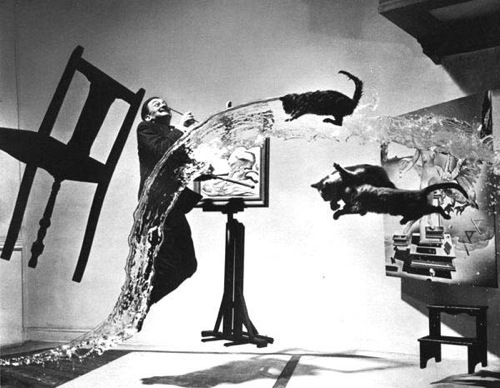
Philippe Halsman: Dali Atomicus (1948)


Salvador Dali: Three Sphinxes of Bikini (1947)


Between the years of 1946 and 1958 (after world war two), the United States conducted 23 nuclear tests at the Micronesian atoll, Bikini. The tests caused the radioactive contamination of the entire system of islands. The (almost) two hundred Micronesians who inhabited the islands were relocated by the US before the tests, and eventually brought back in 1968 (!). The US lost a lawsuit to the Micronesians in the amount of $100 million when it was discovered, ten years later in 1978, that the levels of radioactivity were still dangerously high.
Salvador Dali - Surrealist
These experimental explosions on the atoll of Bikini inspired Dali to paint the Three Sphinxes with their mushroom cloud-like appearance. Dali is considered the greatest of all the surrealist painters. If you look at the point of view of “expressionism,” then paintings in general are supposed to emphasise the expression of inner experience and/or emotion rather than a solely “photographic” portrayal or observational view of reality. It is subjective emotions and responses that objects and events arouse in the artist that concerned the Expressionist artists.

In surrealism, this goes one step further: it’s the unconscious that is emphasised, and paintings express the workings of the mind, the unconscious, memories and dream states by using symbolic imagery and interesting juxtaposition of subject matter.

Burn brightly, Pete

Wednesday, 17 August 2011

Quote of the Day


"Have no fear of perfection 
 - you'll never reach it."
               – Salvador Dali

Salvador Dali: Baby Map of the World (1939)


Thursday, 7 July 2011

The Last Dali

The final painting by the surrealist master has no evidence of his usual images of his beloved Gala and suggestively warped realities. Surrealist superstar Salvador Dalí's last series of paintings were enamoured with a different muse — dynamic mathematics. Dalí’s very last painting The Swallow’s Tail (1983),  contemplated the catastrophe theory dealing with unpredictable sudden changes within mathematical equations.


Burn brightly, Pete